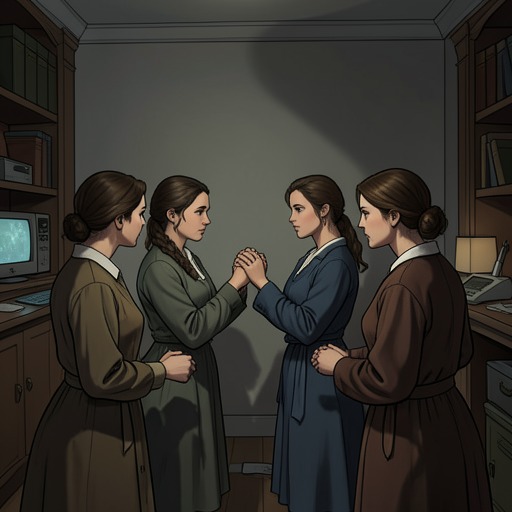
Adela and Martirio’s final confrontation
The House of Bernarda AlbaAdela and Martirio’s final confrontation is the moment their rivalry over Pepe el Romano becomes explicit, exposing the secret relationship and unrequited love that have divided them. Its consequences reach beyond the sisters’ argument: the revelation sends Bernarda after Pepe and, when Martirio falsely says he is dead, leads Adela to take her own life. The scene makes private desire collide with the household’s enforced silence and its concern for public reputation.
Background and Disclosure
The confrontation follows a succession of warnings and discoveries. Poncia tells Bernarda that Pepe has been seen speaking with Angustias at half-past four in the morning, but Bernarda dismisses the warning and asserts her authority. Later, Poncia tells the Servant that Adela is determined to have Pepe and that Martirio will do everything she can to stop her. Bernarda’s confidence that nothing serious is happening stands against the servants’ growing alarm.
At night, Adela slips out toward the yard while María Josefa enters carrying a lamb and singing to it. María Josefa tells Martirio that she intends to escape and warns that Pepe will destroy the young women in the household. After persuading the old woman to return to her room, Martirio calls Adela back from the yard. Adela appears with her hair dishevelled and straw on her petticoat, details that make clear she has been with Pepe in the stable. Martirio’s threat to expose the affair thus becomes an immediate confrontation with evidence of Adela’s secret meetings.
The Sisters’ Conflict
Adela openly boasts of her relationship with Pepe and says that he will be hers. Martirio answers not only as the person threatening to reveal the secret, but as another woman in love with him: under pressure from Adela, she cries out that she loves him too. The disclosure changes the quarrel from an attempt to control Adela’s conduct into a direct contest between the sisters, both attached to the same man but differently positioned within the household.
Their conflict is intensified by the conditions in which they live. Bernarda’s rule confines her daughters and regulates their conduct, while the household’s concern with reputation makes discovery dangerous. Earlier, the villagers’ pursuit of an unmarried mother exposes the violence that can follow a woman’s sexual transgression: Poncia reports that the woman’s baby was killed and that the villagers want to kill her. Adela protests against that threatened violence, while Bernarda urges the crowd on. The episode places the sisters’ private dispute in a community where women bear the consequences of sexual shame far more directly than men.
From Confrontation to Tragedy
The sisters’ raised voices bring Bernarda from her bed. When Martirio tells her that Adela has been with Pepe in the stable, Bernarda rushes out in search of him and a shot is heard. Martirio then claims that Pepe is dead. Adela, believing the report, runs into another room and locks the door. After Martirio reveals that Pepe escaped, Poncia’s actions make clear that Adela has hanged herself.
The false report is the decisive reversal in the confrontation: Pepe is alive, but Adela acts on the belief that he is dead. The sequence links Martirio’s disclosure of her love and her role in the dispute to the catastrophe without making her claim that Pepe has died true. Bernarda responds by ordering that Adela’s body be taken down and that everyone say she died a virgin. She also commands that a new period of mourning begin, turning the aftermath into another effort to control what the household and village will know.
Social and Dramatic Significance
The confrontation concentrates the play’s tensions between desire and repression, private knowledge and public appearance. The sisters’ feelings become speakable only in a quarrel that Bernarda’s authority cannot contain; once the secret is exposed, the family’s response is not to acknowledge it but to impose silence and protect its reputation. Bernarda’s insistence on presenting Adela as a virgin makes the household’s public account directly conflict with what the events have disclosed.
The episode also belongs to the play’s wider picture of contemporary Spanish village life. Lorca’s documentary aim and subtitle, “A Drama of Women in the Villages of Spain,” frame the household conflict as more than an isolated rivalry. The sisters face restrictions shaped by traditional gender roles and a sexual double standard, while the villagers’ pursuit of the unmarried mother shows how communal judgement can become a threat of physical punishment. The confrontation’s tragic outcome gives those social pressures a domestic form: the secret is revealed, but the authority governing the house answers revelation with concealment.